















[See below for English version]
Viele Unternehmen entwickeln erfolgreiche KI-Prototypen – doch der Schritt in den produktiven Einsatz gelingt nur selten. Genau dieser Herausforderung widmete sich der Workshop „Mit KI-Engineering zum erfolgreichen KI-Projekt – KI-Anwendungen jenseits des Prototyps“ mit den Referent:innen Dr. Constanze Hasterok, Ann-Kathrin Goßmann und Dr.-Ing. Thomas Usländer vom Fraunhofer IOSB. Die Veranstaltung fand im Rahmen der Reihe „Dein Einstieg in KI“ des European Digital Innovation Hub Applied Artificial Intelligence and CyberSecurity (EDIH-AICS) statt.
Studien wie die Deloitte State of AI in the Enterprise (2022) zeigen: Rund 95 % der KI-Projekte scheitern nicht an der Technologie, sondern an Struktur, Datenqualität, Rollenverantwortlichkeiten und fehlender Übertragbarkeit in den laufenden Betrieb.
Genau hier setzt KI-Engineering an: als neue Ingenieursdisziplin, die Methoden und Prozesse bereitstellt, um KI-Systeme planbar, kontrollierbar und vertrauenswürdig zu entwickeln – von der Idee bis zum langfristigen Betrieb. Nicht technische Innovation ist der Engpass, sondern das Fehlen einer ingenieurmäßigen Systematik, bei der Daten, Prozesse, Qualitätssicherung, Infrastruktur und Regulatorik von Anfang an zusammengedacht werden.
Dr. Constanze Hasterok konzentriert sich auf die standardisierte und nachhaltige Entwicklung industrieller KI-Systeme. Dr.-Ing. Thomas Usländer prägt das Themenfeld KI-Engineering wesentlich mit. Er beschreibt es als systematische Entwicklung und Betrieb von KI-basierten Lösungen im Kontext komplexer Systeme – eingebettet in Datenräume, offene Systemarchitekturen und industrielle Plattformökonomie.
KI-Engineering verfolgt einen strukturierten Ansatz mit Fokus auf:
- Frühe systematische Definition von KI-Systemen und ihrer Rolle im Gesamtsystem
- Daten als eigenständige Systemkomponenten mit klaren Qualitätsanforderungen
- Sicherstellung von Transparenz, Wartbarkeit und Zuverlässigkeit
- Planbarem Übergang vom Prototyp zum produktiven System
PAISE® – Das Vorgehensmodell für KI-Systeme
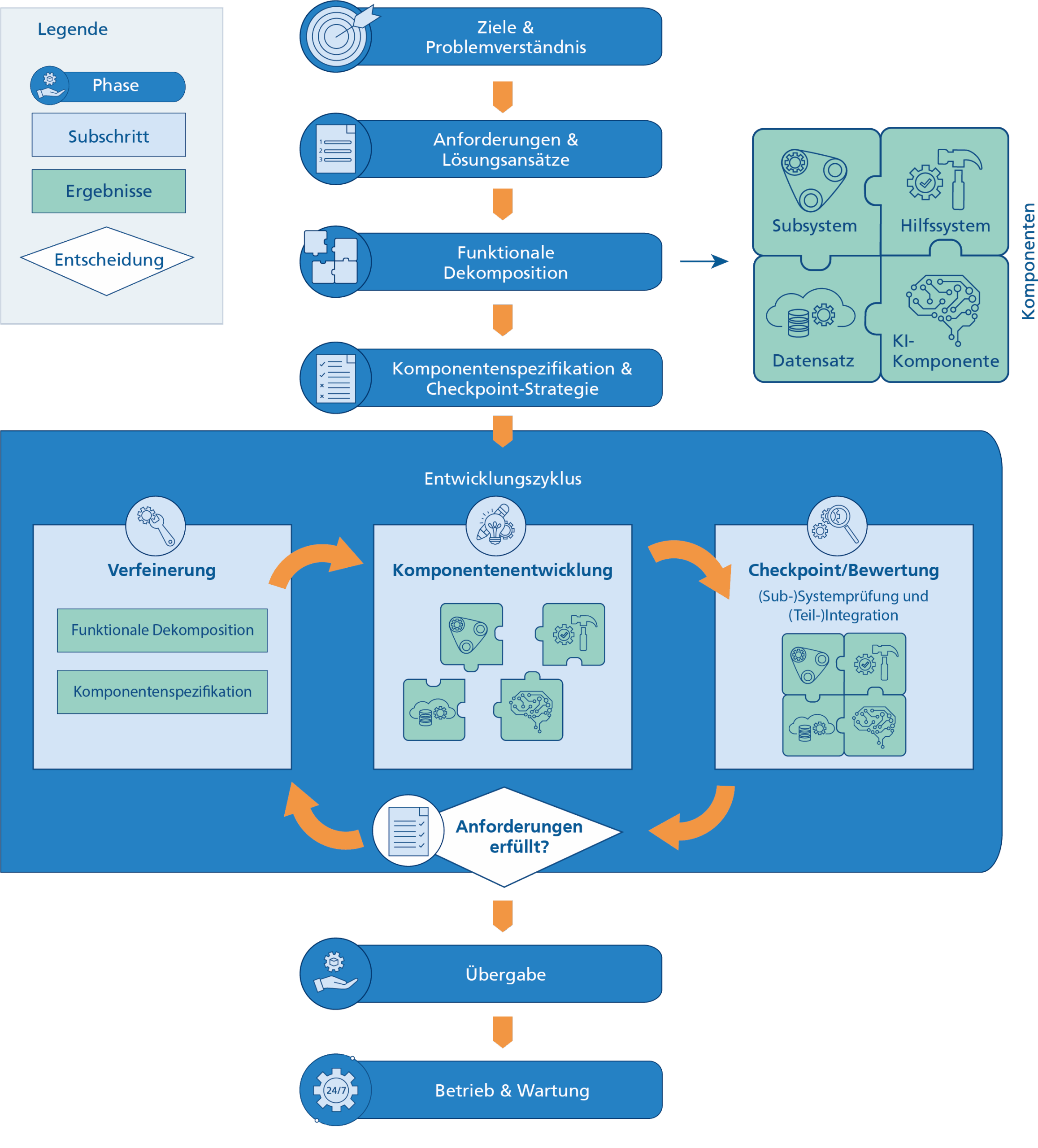
Im Workshop wurde das Vorgehensmodell PAISE® (Process Model for AI Systems Engineering) vorgestellt. Es verbindet klassische Ingenieursmethodik mit agilen KI-Ansätzen und beschreibt, wie KI-Systeme vom Konzept bis zum Betrieb umgesetzt werden.
Das PAISE®-Modell umfasst sechs Phasen:
- Problem- und Zieldefinition: Anwendung, Nutzen, Anforderungen und Kontext klären
- Funktionale Dekomposition: Gesamtsystem in Komponenten zerlegen, KI-Funktionen und Datenquellen definieren
- Komponentenspezifikation: Festlegung der detaillierten Funktionen und Schnittstellen aller Komponenten als Grundlage für Entwicklung, Integration und Qualitätssicherung
- Entwicklungszyklus:
- Aufbau und Analyse der Datenbasis: Datenumfang, Qualität, Drifts, Bias und Repräsentativität bewerten
- Entwicklung und Training der KI-Komponenten: Modelltraining, Validierung, Robustheit und Erklärbarkeit sichern
- Übergabe: Übergabe an Kunden/Betreibende, Technische Einbettung in finale IT-, Produktions- oder Cloud-Umgebungen; Monitoring und Wartung planen
- Betrieb und Wartung: Drifterkennung, Retraining, Verbesserungen
Warum ist PAISE® so relevant? Es adressiert drei zentrale Hürden industrieller KI-Projekte:
- Die schwer planbare Leistungsfähigkeit von ML-Komponenten
- Datenknappheit in frühen Projektphasen
- Die methodische Einbindung regulatorischer Anforderungen wie dem AI-Act
Praxisbeispiel aus dem Workshop
Anhand eines realen Use Cases aus der Lebensmittelproduktion wurde das PAISE®-Modell praktisch im Workshop angewendet: Wie lässt sich die Qualität einer Tiefkühlpizza bereits während der Herstellung mithilfe von KI prognostizieren?
Die Teilnehmenden identifizierten Einflüsse auf die Qualität, wie Teigbeschaffenheit, Backzeit, Temperatur und Sensorinformationen. Sie zerlegten das System funktional, identifizierten Datenquellen und definierten erste Entwicklungsschritte – genau nach dem PAISE®-Ansatz.
EU AI-Act – Regulatorik als Innovationstreiber
Parallel zur technischen Umsetzung müssen Unternehmen regulatorische Anforderungen berücksichtigen. Der EU AI-Act schafft dafür einen verbindlichen europäischen Rahmen für Sicherheit, Transparenz und ethischen Einsatz von KI.
Der AI-Act verfolgt drei zentrale Ziele:
- Grundrechte schützen
- Vertrauen und Wettbewerbsfähigkeit stärken
- Risiken durch fehlerhafte oder intransparente KI-Anwendungen minimieren
Die Verordnung unterscheidet vier Risikokategorien:
- Minimales Risiko – KI etwa in Spielen oder einfachen Automatisierungen, ohne spezifische Auflagen
- Geringes Risiko – z. B. Chatbots oder Empfehlungssysteme, mit Transparenzanforderungen
- Hohes Risiko – etwa KI in kritischer Infrastruktur, Gesundheitswesen, Personalmanagement oder Industrie; hier gelten strenge Anforderungen an Dokumentation, Überwachung und Governance
- Unannehmbares Risiko – etwa Social Scoring oder manipulative Echtzeitüberwachung; diese Anwendungen sind vollständig verboten
Unternehmen müssen daher frühzeitig klären, in welche Risikokategorie ihre KI-Anwendung fällt. KI-Engineering liefert die Methodik, um technische, organisatorische und regulatorische Anforderungen von Anfang an zu integrieren.
„Die Anforderungen aus der Gesetzgebung und an die Qualität betreffen das Gesamtsystem. KI-Engineering hilft, diese von Beginn an systematisch abzubilden.“ — Dr.-Ing. Thomas Usländer
Fazit
Der Weg zu erfolgreichen KI-Anwendungen verläuft über zwei Achsen:
- Technische Exzellenz durch KI-Engineering: Struktur, Datenstrategie, Qualität, Verantwortlichkeiten und nachhaltiger Betrieb
- Regulatorische Sicherheit durch den AI-Act: Vertrauen, Transparenz, Risiko- und Compliance-Management
Unternehmen, die beide Perspektiven frühzeitig vereinen, entwickeln nicht nur funktionierende KI-Systeme – sondern nachhaltige, vertrauenswürdige und wirtschaftlich erfolgreiche Lösungen.
Klingt spannend? Wer sich weiter mit dem Thema beschäftigen möchte, findet auf der Website „KI-Anwendungen jenseits des Prototyps“ des Fraunhofer IOSB zusätzliche Informationen. Dort wird auch das zweitägige Seminar „KI-Projektmanagement – Wie gelangt KI in den produktiven Einsatz?“ angeboten. Die entsprechenden Kontaktpersonen sind ebenfalls dort zu finden.
Der European Digital Innovation Hub Applied Artificial Intelligence and CyberSecurity (EDIH-AICS)
Der EDIH-AICS ist ein europäisches Projekt, das darauf abzielt, Künstliche Intelligenz und Cybersicherheit in den Bereichen Produktion, Mobilität, Energie, Handel und Dienstleistungen sowie bei Kommunen europaweit zu stärken und voranzubringen.
Gemeinsam mit exzellenten Partnern aus der erweiterten TechnologieRegion Karlsruhe bietet das CyberForum Angebote für lokale, nationale und europäische kleine und mittlere Unternehmen (KMU), Startups und Organisationen des öffentlichen Sektors an, um ihre Unternehmen zu digitalisieren.
Das Projekt wird durch das Rahmenprogramm Digital Europe (DIGITAL) der Europäischen Union unter der Grant Agreement Nummer 101083994 gefördert.


From Prototype to Productive AI –
AI Engineering and the EU AI Act as drivers of the future
Many companies develop successful AI prototypes – but the step into productive deployment rarely succeeds. This exact challenge was the focus of the workshop “With AI Engineering to a successful AI project – AI applications beyond the prototype” with speakers Dr. Constanze Hasterok, Ann-Kathrin Goßmann, and Dr.-Ing. Thomas Usländer from Fraunhofer IOSB. The event took place as part of the series “Your entry into AI” organized by the European Digital Innovation Hub Applied Artificial Intelligence and CyberSecurity (EDIH-AICS).
Studies such as Deloitte State of AI in the Enterprise (2022) show: around 95% of AI projects do not fail because of technology, but due to structure, data quality, role responsibilities, and the lack of transferability into ongoing operations.
This is precisely where AI Engineering comes in: as a new engineering discipline that provides methods and processes to develop AI systems in a predictable, controllable, and trustworthy way – from the initial idea to long-term operation. The bottleneck is not technical innovation, but the absence of an engineering-based systematics, where data, processes, quality assurance, infrastructure, and regulation are considered together from the very beginning.
Dr. Constanze Hasterok focuses on the standardized and sustainable development of industrial AI systems. Dr.-Ing. Thomas Usländer has significantly shaped the field of AI Engineering. He describes it as the systematic development and operation of AI-based solutions in the context of complex systems – embedded in data spaces, open system architectures, and the industrial platform economy.
AI Engineering follows a structured approach with a focus on:
- Early systematic definition of AI systems and their role in the overall system
- Data as independent system components with clear quality requirements
- Ensuring transparency, maintainability, and reliability
- A predictable transition from prototype to productive System
PAISE® – The process model for AI Systems

The workshop introduced the PAISE® (Process Model for AI Systems Engineering) approach. It combines classical engineering methodology with agile AI practices and describes how AI systems can be implemented from concept to operation.
The PAISE® model consists of six phases:
- Problem and goal definition: Clarify application, benefits, requirements, and context
- Functional decomposition: Break down the overall system into components, define AI functions and data sources
- Component specification: Define detailed functions and interfaces of all components as the basis for development, integration, and quality assurance
- Development cycle:
– Build and analyze the database: assess scope, quality, drifts, bias, and representativeness
– Develop and train AI components: ensure model training, validation, robustness, and explainability
- Handover: Transfer to customers/operators, embed technically into final IT, production, or cloud environments; plan monitoring and maintenance
- Operation and maintenance: Drift detection, retraining, improvements
Why is PAISE® so relevant? It addresses three central hurdles of industrial AI projects:
- The difficult-to-predict performance of ML components
- Data scarcity in early project phases
- The methodological integration of regulatory requirements such as the AI Act
Practical example from the Workshop
Using a real use case from food production, the PAISE® model was applied in practice: How can the quality of a frozen pizza be predicted during manufacturing with the help of AI?
Participants identified influences on quality such as dough consistency, baking time, temperature, and sensor information. They decomposed the system functionally, identified data sources, and defined initial development steps – exactly following the PAISE® approach.
EU AI Act – Regulation as a driver of innovation
In parallel with technical implementation, companies must consider regulatory requirements. The EU AI Act creates a binding European framework for safety, transparency, and the ethical use of AI.
The AI Act pursues three central goals:
- Protect fundamental rights
- Strengthen trust and competitiveness
- Minimize risks from faulty or non-transparent AI applications
The regulation distinguishes four risk categories:
- Minimal risk – AI in games or simple automation, without specific requirements
- Limited risk – e.g., chatbots or recommendation systems, with transparency obligations
- High risk – AI in critical infrastructure, healthcare, HR management, or industry; strict requirements apply for documentation, monitoring, and governance
- Unacceptable risk – e.g., social scoring or manipulative real-time surveillance; these applications are completely prohibited
Companies must therefore clarify early on which risk category their AI application falls into. AI Engineering provides the methodology to integrate technical, organizational, and regulatory requirements from the outset.
“The requirements from legislation and for quality affect the entire system. AI Engineering helps to systematically map these from the very beginning.” — Dr.-Ing. Thomas Usländer
Conclusion
The path to successful AI applications runs along two axes:
- Technical excellence through AI Engineering: structure, data strategy, quality, responsibilities, and sustainable operation
- Regulatory security through the AI Act: trust, transparency, risk and compliance management
Companies that unite both perspectives early on develop not only functioning AI systems – but sustainable, trustworthy, and economically successful solutions.
Sounds interesting? Those who want to explore the topic further can find additional information on the Fraunhofer IOSB website “AI Applications Beyond the Prototype”. There, the two-day seminar “AI project management – How does AI reach productive deployment?” is also offered, along with relevant contact persons.
The European Digital Innovation Hub Applied Artificial Intelligence and CyberSecurity (EDIH-AICS)
The EDIH-AICS is a European project that aims to strengthen and advance artificial intelligence and cyber security in the areas of production, mobility, energy, trade and services, as well as in local authorities across Europe.
Together with excellent partners from the extended Karlsruhe TechnologyRegion, CyberForum offers services for local, national and European small and medium-sized enterprises (SMEs), start-ups and public sector organisations to help them digitise their businesses.
The project is funded by the Digital Europe Programme (DIGITAL), a framework programme of the European Union under Grant Agreement number 101083994.